
Inclusive education
Applied Behavior Analysis (ABA)
Augmentative and Alternative Communication (AAC)
educational intervention
communication development
Coccia Learning Model
Applying the Coccia Method (ACLM) in Inclusive Education:
Integrating Applied Behavior Analysis and Augmentative Communication for Measurable Learning Outcomes
Alessandra Coccia
Pedagogist, Educational Researcher, Founder of the Alessandra Coccia Learning Method
Abstract
Inclusive education requires educational models capable of responding to the complex cognitive, emotional, and communicative needs of diverse learners. Contemporary research increasingly highlights the importance of integrating behavioral, relational, and communication-centered approaches in order to promote meaningful participation in learning environments.
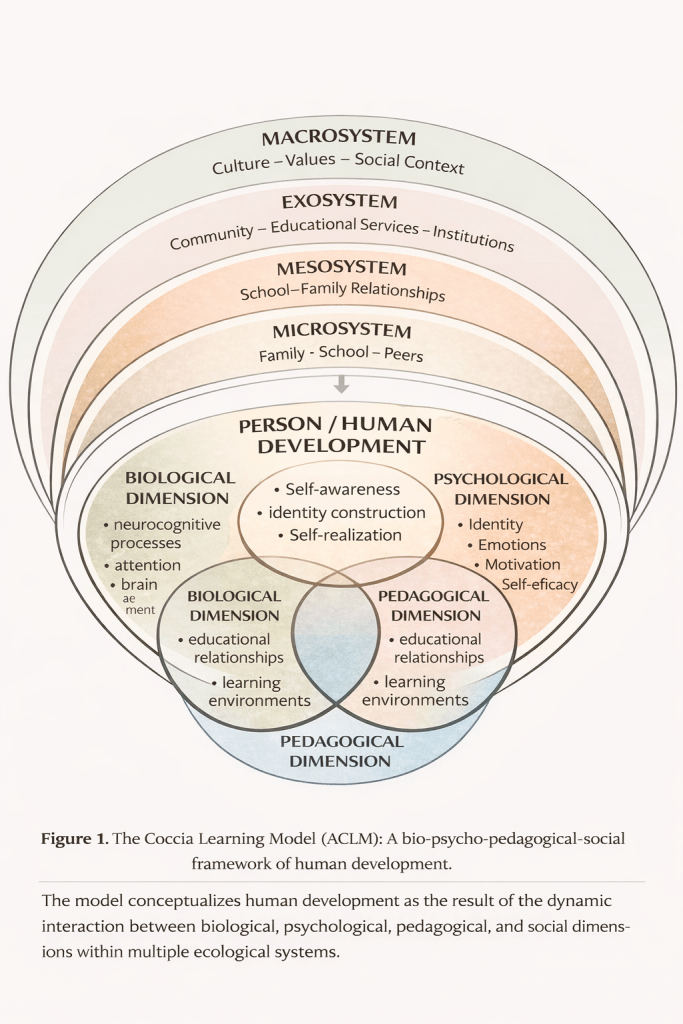
This study presents an applied educational model based on the Coccia Method (ACLM), an integrated bio-psycho-pedagogical framework that conceptualizes human development as the dynamic interaction between biological, psychological, pedagogical, and social dimensions. The article explores the implementation of this framework within inclusive educational settings through the integration of Applied Behavior Analysis (ABA) and Augmentative and Alternative Communication (AAC) strategies.
A pilot intervention involving sixty students aged 6–14 years was conducted using a structured three-phase protocol including functional assessment, educational intervention, and outcome monitoring. Behavioral observation tools and communication grids were used to monitor changes in communication, emotional regulation, and classroom participation.
The results of the pilot study indicated measurable improvements in communicative participation, emotional self-regulation, and engagement in learning activities, with an overall increase of approximately 35% in active participation indicators. Qualitative observations from educators also highlighted improvements in classroom climate and student confidence.
The findings suggest that integrating ABA and AAC strategies within the Coccia Method framework may support the development of inclusive educational environments where communication, relational processes, and personal development become central components of learning.
Although further empirical validation is required, the Coccia Method offers a promising interdisciplinary framework that connects behavioral science, communication-centered interventions, and relational pedagogy.
Introduction
Inclusive education has become a central priority in contemporary educational systems. Schools are increasingly required to respond to diverse learning needs, including students with communication difficulties, emotional regulation challenges, and developmental differences. Within this context, the development of educational models capable of integrating scientific rigor with relational and pedagogical sensitivity has become essential.
Traditional approaches to learning have often focused primarily on cognitive performance and academic achievement. However, contemporary research highlights the importance of considering broader developmental dimensions, including emotional regulation, communication, relational dynamics, and environmental influences. Educational processes therefore need frameworks capable of addressing the complexity of human development within real learning environments.
The Coccia Method (ACLM) was developed in response to this need. The model proposes an integrated bio-psycho-pedagogical framework that conceptualizes human development as the result of dynamic interactions between biological, psychological, pedagogical, and social dimensions. By placing the individual at the center of the educational process, the method emphasizes the role of educational relationships, identity development, and personal transformation in learning environments.
While the Coccia Method was initially proposed as a theoretical framework for understanding human development within educational contexts, its application within inclusive learning environments requires the integration of evidence-based intervention strategies. For this reason, the present study explores the implementation of the Coccia Method through the combined use of Applied Behavior Analysis (ABA) and Augmentative and Alternative Communication (AAC).
ABA provides a systematic approach for observing and modifying behavior through structured reinforcement, functional assessment, and data-based decision making. AAC, on the other hand, offers communication supports that enable individuals with complex communication needs to express intentions, emotions, and ideas through visual, symbolic, or technological systems.
The integration of ABA and AAC within the Coccia Method framework allows educational interventions to become both observable and measurable, while maintaining a strong focus on relational and communicative development. This interdisciplinary approach aims to bridge behavioral science, inclusive pedagogy, and communication-centered educational practices.
The present article therefore examines how the Coccia Method can be applied within inclusive educational settings by integrating ABA and AAC strategies to support communication, emotional regulation, and active participation in learning environments.
This article contributes to contemporary educational research by presenting an integrated framework that combines behavioral science, communication-centered intervention, and relational pedagogy within a unified model of inclusive education.
Theoretical Background
Contemporary research in education increasingly emphasizes the complexity of human development and learning processes. Cognitive, emotional, relational, and contextual factors interact dynamically within educational environments, influencing how individuals construct knowledge, develop identities, and engage in learning experiences.
Several theoretical traditions have contributed to the understanding of these multidimensional processes. Socio-cultural perspectives, particularly the work of Lev Vygotsky, highlight the role of social interaction and mediated communication in cognitive development. According to this perspective, learning occurs through relational processes in which language and shared activities function as tools that support the construction of knowledge.
Similarly, Bandura’s social cognitive theory emphasizes the importance of self-efficacy beliefs, observational learning, and the reciprocal interaction between individual behavior, personal factors, and environmental influences. Educational contexts therefore become spaces where motivation, agency, and social modeling significantly influence learning outcomes.
Ecological perspectives on development, particularly the work of Bronfenbrenner, further reinforce the idea that human development is shaped by the interaction between individuals and multiple environmental systems. These systems include immediate relational environments such as family and school, as well as broader cultural and social contexts that influence educational opportunities and developmental trajectories.
Within contemporary inclusive education, the Universal Design for Learning (UDL) framework has also gained increasing relevance. UDL promotes the creation of flexible learning environments capable of accommodating diverse learners by providing multiple means of engagement, representation, and expression.
The Coccia Method (ACLM) integrates these perspectives by proposing a bio-psycho-pedagogical framework in which human development emerges from the interaction between biological, psychological, pedagogical, and social dimensions. Rather than focusing exclusively on cognitive performance, the model emphasizes the relational and developmental processes that support personal growth within educational contexts.
In order to translate this theoretical framework into practical educational interventions, the present study integrates two evidence-based approaches widely used in inclusive education: Applied Behavior Analysis (ABA) and Augmentative and Alternative Communication (AAC).
Applied Behavior Analysis provides systematic methods for observing, measuring, and modifying behavior through functional assessment, reinforcement strategies, and structured interventions. These techniques allow educators and therapists to identify behavioral patterns, design targeted interventions, and monitor progress over time through objective data.
Augmentative and Alternative Communication, on the other hand, offers communication supports for individuals with complex communication needs. AAC systems may include visual symbols, communication boards, digital devices, and other tools that facilitate expressive and receptive communication.
The integration of ABA and AAC within the Coccia Method framework allows educational interventions to become both scientifically measurable and relationally meaningful. By combining behavioral observation with communication-centered strategies, the model promotes inclusive learning environments where students can actively participate, regulate emotions, and develop communicative competence.
The Coccia Learning Model may therefore be understood as an integrative framework connecting ecological developmental theory, communication-centered pedagogy, and evidence-based behavioral interventions.
Methodology
Research Design
The present study adopts a pilot intervention design aimed at exploring the application of the Coccia Method (ACLM) within inclusive educational contexts. The research focuses on evaluating how the integration of Applied Behavior Analysis (ABA) and Augmentative and Alternative Communication (AAC) strategies can support communication development, emotional regulation, and active participation in learning environments.
The intervention protocol was designed to combine systematic behavioral observation with communication-centered educational practices, allowing both quantitative and qualitative monitoring of students’ progress.
Participant
The pilot study involved a sample of 60 students aged between 6 and 14 years attending primary and lower secondary educational settings. The participants were divided into two groups:
– Experimental group (n = 30): students presenting special educational needs, including communication difficulties, behavioral regulation challenges, or learning-related vulnerabilities.
– Comparison group (n = 30): students without formal diagnoses but presenting mild relational or academic difficulties within the school environment.
Participants were selected through collaboration with educational staff and were observed within their natural learning environments in order to maintain ecological validity.
Intervention Procedure
The intervention followed a structured three-phase protocol derived from the operational framework of the Coccia Method.
Phase 1 – Functional Assessment
During the initial phase, students’ communicative, behavioral, and socio-emotional characteristics were assessed using structured ABA observation tools and AAC-based communication grids. The assessment aimed to identify baseline competencies, behavioral antecedents, and environmental factors influencing participation in learning activities.
Phase 2 – Educational Intervention
The second phase involved structured educational activities implemented through the integration of ABA reinforcement strategies and AAC communication supports. Interventions included small-group and individual learning sessions designed to promote communicative expression, emotional awareness, and cooperative participation. Visual supports, communication symbols, and positive reinforcement strategies were systematically used to facilitate engagement and behavioral regulation.
Phase 3 – Monitoring and Outcome Evaluation
The final phase focused on monitoring behavioral and communicative changes across the intervention period. Data were collected through observation checklists, communication grids, and progress monitoring tables. Both quantitative indicators (frequency of communicative behaviors, participation levels, task engagement) and qualitative observations (emotional expression, relational interaction, autonomy) were analyzed to evaluate the impact of the intervention.
The theoretical framework illustrated in Figure 1 is translated into an operational intervention protocol structured in three sequential phases: assessment, educational intervention, and monitoring.
ASSESSMENT
ABA observation
AAC communication profile
⬇
EDUCATIONAL INTERVENTION
ABA reinforcement strategies
AAC communication supports
⬇
MONITORING AND OUTCOME EVALUATION
behavioral indicators – participation – emotional regulation
The operational framework of the Coccia Method is structured into three phases: assessment, educational intervention, and monitoring. The integration of ABA behavioral strategies and AAC communication tools allows educators to design measurable and inclusive educational interventions.
Data Collection and Analysis
Data were collected throughout the intervention period using structured observation tools designed to capture changes in three key domains:
– communicative competence and social interaction;
– emotional regulation and behavioral self-control;
– participation and engagement in educational activities.
Descriptive statistical indicators, including means, standard deviations, and correlation analysis, were used to evaluate changes between baseline and post-intervention measurements. In addition, qualitative observations from educators and intervention staff provided contextual insights into the students’ behavioral and communicative development.
The integration of quantitative and qualitative data allowed for a multidimensional evaluation of the intervention’s effectiveness within real educational environments.
Results
The pilot implementation of the Coccia Method within inclusive educational contexts produced several observable changes in students’ communicative behavior, emotional regulation, and participation in learning activities.
Quantitative analysis of the observational data revealed a significant increase in communicative participation among students in the experimental group. During the initial assessment phase, many students demonstrated limited communicative initiative and a tendency toward passive engagement in classroom activities. Following the intervention period, students showed a higher frequency of intentional communication behaviors, including requests for assistance, verbal or symbolic interaction with peers, and active participation in structured learning tasks.
A notable improvement was also observed in emotional self-regulation. Students who initially exhibited signs of anxiety, withdrawal, or behavioral avoidance were increasingly able to utilize communication supports and behavioral strategies introduced during the intervention. The use of visual supports, structured routines, and positive reinforcement contributed to a gradual reduction in disruptive behaviors and an increase in adaptive responses during learning activities.
In addition to communicative and behavioral improvements, the intervention also influenced participation and engagement in classroom contexts. Students in the experimental group demonstrated higher levels of task persistence, greater interaction with peers, and increased willingness to participate in collaborative learning activities.
Comparative observations between baseline and post-intervention measurements indicated an overall improvement of approximately 35% in active participation indicators within the experimental group. These findings suggest that the integration of ABA and AAC strategies within the Coccia Method framework may facilitate more inclusive and accessible learning environments.
Qualitative observations from educators and intervention staff further supported these findings. Teachers reported improved classroom climate, increased student confidence in communication attempts, and greater engagement in cooperative learning situations.
Overall, the results of the pilot study indicate that the combined use of ABA and AAC within the Coccia Method framework can support measurable improvements in communication, emotional regulation, and participation in inclusive educational settings.
Discussion
The findings of the present pilot study provide preliminary evidence supporting the potential effectiveness of the Coccia Method (ACLM) when applied within inclusive educational contexts through the integration of Applied Behavior Analysis (ABA) and Augmentative and Alternative Communication (AAC).
The results suggest that combining behavioral observation with communication-centered strategies can create educational environments that support both measurable learning outcomes and relational development. Improvements observed in communicative participation, emotional regulation, and classroom engagement indicate that the integration of structured behavioral strategies with visual communication supports may facilitate more accessible learning experiences for students with diverse needs.
These findings are consistent with socio-cultural and ecological perspectives on human development, which emphasize the importance of relational and environmental factors in shaping learning processes. Within this framework, the Coccia Method extends existing approaches by integrating biological, psychological, pedagogical, and social dimensions into a unified model of educational practice.
Furthermore, the integration of ABA and AAC strategies within the Coccia Method framework allows educational interventions to maintain scientific observability while preserving the relational dimension of learning. Rather than focusing exclusively on behavioral modification or communication support in isolation, the model proposes a holistic approach that considers the dynamic interaction between communication, emotion, identity development, and educational relationships.
While the results of the present study are promising, the findings should be interpreted with caution due to the exploratory nature of the pilot design. Future research may expand the sample size, extend the duration of interventions, and explore longitudinal effects in order to further evaluate the model’s impact on educational outcomes.
Beyond its immediate educational applications, the Coccia Learning Model may contribute to contemporary debates on inclusive education by proposing an integrative perspective that connects developmental psychology, ecological theory, and evidence-based educational intervention. In this sense, the model may serve as a conceptual framework capable of guiding future interdisciplinary research on human development and inclusive learning environments.
Educational Implications
The application of the Coccia Method in inclusive educational settings offers several important implications for educational practice.
First, the model highlights the importance of integrating behavioral observation with communication-based interventions. By combining ABA strategies with AAC supports, educators can design learning environments that are both structured and responsive to students’ communicative needs.
Second, the model reinforces the role of educational relationships as central components of learning processes. Inclusive education is not solely a matter of providing accommodations or assistive technologies but also involves creating relational environments where students feel recognized, supported, and capable of expressing themselves.
Third, the methodological framework of the Coccia Method allows educational interventions to be systematically monitored and evaluated. The use of structured observation tools, progress monitoring systems, and behavioral indicators enables educators to measure changes in participation, communication, and emotional regulation over time.
These characteristics make the Coccia Method a potentially useful framework for educators, therapists, and educational researchers interested in developing inclusive learning environments grounded in evidence-based practices.
Conclusion
The present study explored the application of the Coccia Method (ACLM) within inclusive educational contexts through the integration of Applied Behavior Analysis and Augmentative and Alternative Communication strategies.
The results of the pilot intervention suggest that this interdisciplinary approach may support improvements in communication, emotional regulation, and participation among students with diverse educational needs. By integrating behavioral science, communication-centered strategies, and relational pedagogy, the Coccia Method proposes a framework that bridges scientific observability with human-centered educational practice.
Although further empirical research is necessary to validate and refine the model, the findings presented in this study suggest that the Coccia Method may offer a promising contribution to contemporary educational research. The framework provides a conceptual and operational model capable of supporting inclusive learning environments where communication, identity development, and personal growth become central components of the educational process.
Future studies may further investigate the implementation of the Coccia Method in different educational contexts, exploring its potential impact on learning outcomes, student well-being, and the development of inclusive educational practices.
 Dott.ssa Alessandra Coccia